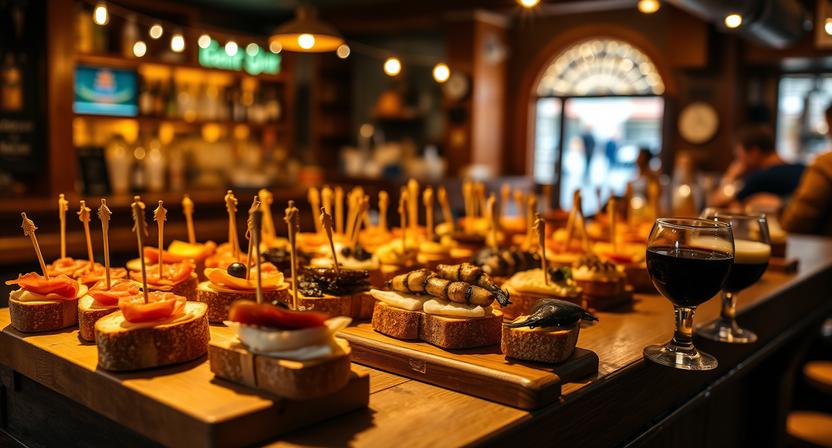
Walk into any bar in Bilbao’s Casco Viejo around 8pm and you’ll see it: a counter lined with small plates, toothpicks holding together tiny towers of bread, seafood, cured meat, and things you can’t quite name yet. This is pintxos culture, and it’s less a meal than a way of moving through the evening.
Most visitors get it wrong on their first try. They sit down, wait for a menu, and wonder why nobody comes to take their order. Pintxos don’t work like restaurant food, and once you understand the rhythm, an entire side of Basque life opens up.
A pintxo (pronounced “peen-cho”) is a small bite, usually served on a slice of bread and held together with a toothpick. The name comes from the Spanish verb pinchar, to pierce or spike, which is exactly how the toothpick works. They’re related to Spain’s more famous tapas, but pintxos are a distinctly Basque tradition, born in the bars of San Sebastián and Bilbao rather than the taverns of Andalusia.
The classics are simple: a slice of tortilla, jamón on bread, a skewer of anchovy and olive. But Basque chefs treat pintxos as a genuine art form. Bilbao in particular has built a reputation for pushing the format, with bars serving foie, seared tuna, and inventive combinations that punch far above their size.
Prices sit around two to three euros per pintxo, and a good night out means moving between several bars rather than settling into one.
Reading the Counter
In most traditional bars, pintxos sit out on the counter under glass or open air. You don’t wait to be served. You look, you point, you take. Some bars also run a small hot menu, called pintxos calientes, which are cooked to order and require asking the bartender directly.
Keep your toothpicks. At the end, the bartender counts them to work out your bill. It sounds chaotic to a first-timer, and it runs on a surprising amount of trust.
The Art of Poteo
Poteo is the local habit of bar-hopping, one or two pintxos and a small glass of wine or beer at each stop before moving on. Nobody sits down for a three-hour dinner here. A pintxos night in Bilbao might touch four or five bars, each one adding a different flavour and a different corner of the city to your evening.
This matters because it changes how you should plan. Don’t fill up at the first bar. Pace yourself, order light, and treat the whole crawl as one long, moving meal.
Ordering Drinks
A small glass of wine, known as a chiquito or txikito, is the standard pairing. Beer comes as a zurito, a small draft poured in a shot-sized glass rather than a full pint. Both exist specifically to keep you moving between bars without slowing down.
The Casco Viejo, Bilbao’s Old Town, is the natural starting point and home to the highest concentration of traditional pintxos bars, many of them family-run for generations. Calle Santa María and Calle del Perro are particularly dense with options.
For a more contemporary take, the streets around Plaza Nueva mix classic bars with newer spots experimenting with technique and presentation. If you head out to Getxo, along the coast, the pintxos style shifts toward seafood, with fresh catch pulled straight from the nearby port.
Go with intention but not with rigidity. Pick a neighbourhood, wander until a bar’s counter catches your eye, and let your route build itself from there.
Watch what locals order. If a bar has a queue of Bilbaínos three deep at 9pm on a Tuesday, that’s a far better signal than any online review.
Ask before assuming. Not every bar operates on the honour system, and some higher-end spots serve pintxos to order rather than lay them out on the counter. A quick glance at what everyone else is doing usually clears this up fast.
Don’t skip the hot pintxos. The cold counter items are what tourists photograph, but some of the best flavours in Bilbao come from the pintxos calientes menu, things like grilled octopus or seared foie that never touch the display counter.
Budget for the whole night, not one bar. Five bars at three pintxos each, with drinks, usually land under 40 euros per person, spread out over an evening rather than one big bill.
If navigating this solo feels like a lot for a first visit, this is exactly the gap our Bilbao Cultural & Pintxos Experience is built to close. A local guide takes you through the actual bars Bilbaínos use, explains the etiquette in real time, and turns what could be an intimidating first attempt into one of the best evenings of the trip.
Bilbao has changed fast over the last two decades, from an industrial city into one of Spain’s most visited destinations. With that growth has come a wave of bars built for tourists rather than locals, slicker, pricier, and often disconnected from the tradition they’re borrowing from.
Pintxos culture, done properly, is a quiet act of resistance to that shift. It’s slow food that moves fast, built on trust, small portions, and neighbourhood loyalty rather than turnover. Choosing to eat the way locals eat, at the bars locals actually use, is one of the simplest ways to support the city’s real economy instead of the version built for Instagram.
This is also why we built our tours around small groups and genuine local knowledge rather than fixed scripts. A good pintxos night can’t really be templated. It depends on which bar has the best tortilla that week, which owner will chat with you about Athletic Bilbao, and which back-street counter nobody’s written about yet.
Pintxos are one of the best windows into everyday Basque life, but the counter, the etiquette, and the best bars aren’t always obvious on a first visit. If you’d rather skip the guesswork and go straight to the bars locals actually love, join our Bilbao Cultural & Pintxos Experience for a small-group evening built around real food, real stories, and real Bilbao.
Free Spirit Bilbao offers authentic walking tours, bike tours, pintxos experiences, and local adventures in Bilbao & Getxo.
Discover the Basque Country through responsible tourism, small groups, and meaningful local connections.
Quick Navigation